The Best Day of the Week to Buy Stocks (Not What You've Heard)
We scanned 35 years of TradeOdds market data for the best day of the week to buy stocks, by hold period, with win rates and medians. 'Buy Monday' is a myth.
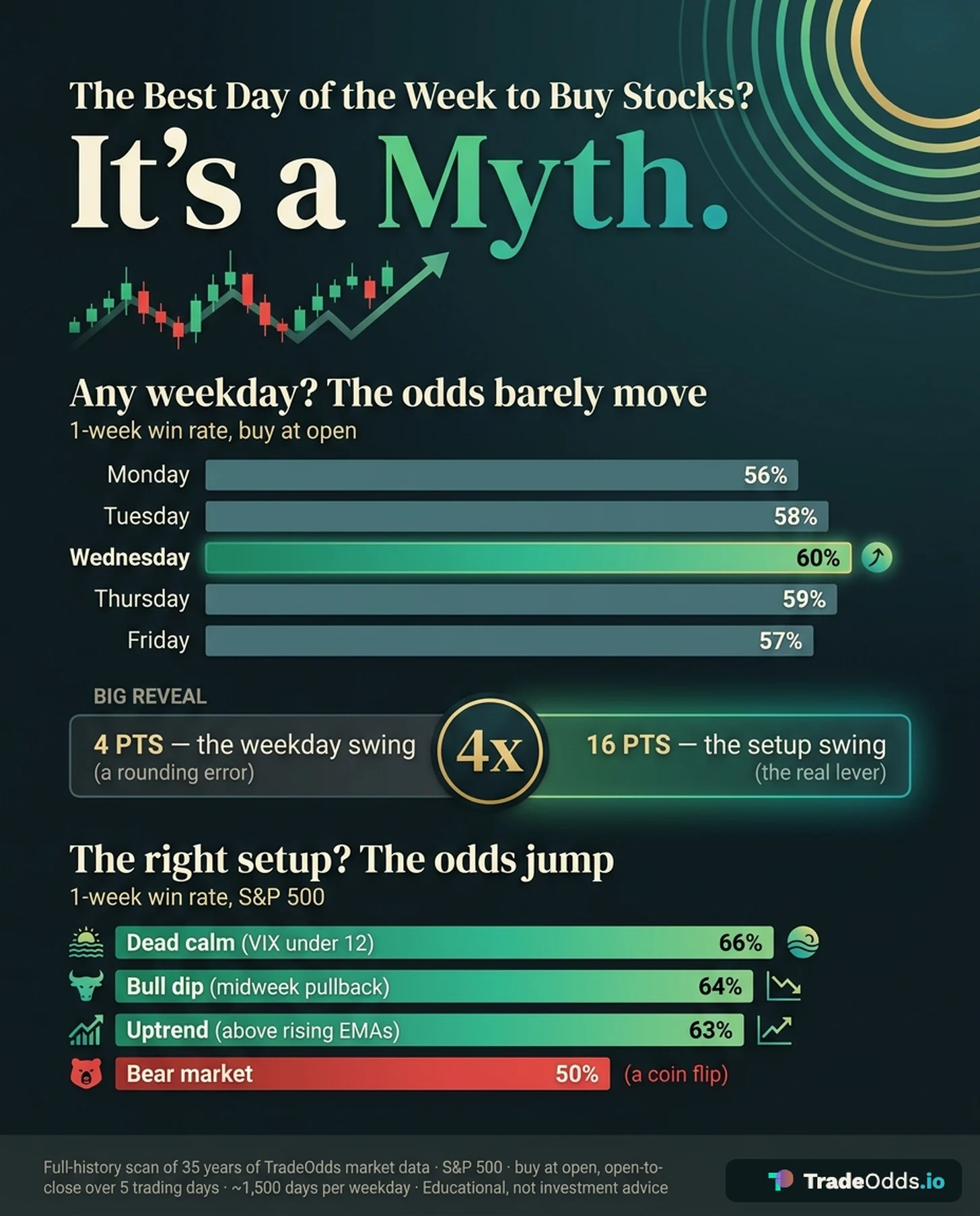
Short version: if you buy the S&P 500 at Wednesday’s open and hold a week, you have been positive about 60% of the time over 35 years, a touch better than any other weekday. Monday and Friday are the softest, near 56%. But before you circle Wednesday on the calendar, here is the part that matters more: on its own, the day of the week is a weak signal, and the popular “buy on Monday” rule is folklore. The real lever is the market condition you buy into. Buy on the right day inside the right setup and the one-week win rate climbs into the mid-60s. This piece shows both halves, with the match counts and medians, so you are reading the record instead of a rule of thumb.
How we tested it, so the numbers actually mean something
Most “best day to buy” articles never tell you what they measured, which makes their answer meaningless. Here is ours, in one breath: we ran a full-history scan across 35 years of TradeOdds market data, and for every trading day we treated the next open as your buy, then measured the return to the close one day, one week (five trading days), and one month (twenty) later. Every matching day is counted, nothing is modeled or forecast. Then we grouped those outcomes by the weekday you actually bought on.
Two things fall out immediately. First, your hold period changes the answer, so any honest “best day” has to name one; a one-day flip and a one-month hold rank the weekdays differently. Second, one number is never enough. The average tells you the size of the typical move, the median tells you the middle outcome once outliers are stripped out, and the win rate tells you how often you were simply positive. We report all three, plus the number of matching days, for every cut below.
The best day of the week to buy stocks, ranked
Here is the whole S&P 500 table, buying at the open on each weekday, across all three holding periods:
| Buy at open on | Days | Next day (avg / win) | Next week (avg / median / win) | Next month (avg / win) |
|---|---|---|---|---|
| Monday | 1,492 | +0.02% / 54% | +0.20% / +0.28% / 56% | +0.94% / 66% |
| Tuesday | 1,629 | +0.01% / 52% | +0.18% / +0.39% / 58% | +0.90% / 65% |
| Wednesday | 1,629 | +0.02% / 54% | +0.23% / +0.40% / 60% | +0.93% / 65% |
| Thursday | 1,596 | +0.00% / 52% | +0.21% / +0.42% / 59% | +0.88% / 65% |
| Friday | 1,588 | −0.01% / 52% | +0.19% / +0.35% / 57% | +0.89% / 65% |
How to read this: a full-history scan of TradeOdds’ S&P 500 data, grouped by the weekday you bought at the open, showing the open-to-close return over the next 1, 5, and 20 trading sessions. “Days” is the number of matching weekdays in the sample.
Read it by hold period. Held a single day, the weekdays are a coin flip with a slight tailwind, nothing to act on. Held a week, a real if modest order appears: Wednesday is the best starting day at a 60% positive rate, while Monday and Friday trail near 56 to 57%. Held a month, everything converges, every weekday is positive about two times in three, and the day you started barely registers, though Monday quietly takes the top spot.
So the honest headline is that the weekday is a minor factor. Buying and holding the S&P for a week has been a roughly 56 to 60 percent proposition no matter which day you pick, and the four-point spread between best and worst is worth knowing but not worth building a plan around by itself. The useful part is underneath.
Why “buy on Monday” is the myth that won’t die
The “buy Monday” advice traces to the Monday effect, academic work from the 1970s and 80s that found Mondays ran slightly negative. It got repeated until it hardened into common knowledge, and it is now decades out of date, backwards, even. For a short one-week hold Monday has actually been one of the softer days to buy, not the best, and its one-day edge is gone entirely. It only redeems itself over a longer month-long hold, and even then by a whisker. Whatever small edge Monday once had was arbitraged away the moment everyone knew about it, which is the fate of every simple calendar rule.
Monday does have its moment, but only in context, and that is the whole point of the next section.
The part that actually helps: when the odds climb into the mid-60s
The weekday looks weak on its own because it is really several opposite patterns averaged together. Separate them by the market condition you are buying into and genuine, well-sampled edges appear. These are the strongest positive setups in the data, buying the S&P at that weekday’s open and holding one week:
| Buy the S&P at open on… | Win rate (1 week) | Median | Matches |
|---|---|---|---|
| Wednesday, inside a bull-market pullback | 64% | +0.79% | 246 |
| Tuesday, inside a bull-market pullback | 63% | +0.81% | 229 |
| Thursday, when the VIX is under 12 (dead calm) | 66% | +0.37% | 130 |
| Any day in a Bullish Stack trend (price above its rising 9 and 21-day EMAs) | 61–63% | +0.5 to +0.6% | ~250 each |
Now the picture is useful. Buying a midweek dip while the broader market is still in an uptrend, “pullback in a bull,” has been positive 63 to 64% of the time over the following week, with a roughly +0.8% median across a few hundred instances, because you are buying weakness inside strength, the classic dip-buy. A dead-calm tape, VIX under 12, has quietly been one of the best backdrops of all.
And the same lens shows you what to avoid. Buying the S&P on a Monday into a downtrend or an outright bear market has been a coin flip, 50 to 51% positive with a flat-to-negative average. Same weekday, opposite outcome, decided entirely by the condition around it, which is exactly why “buy on Monday” with no context is useless.
This is the question TradeOdds is built to answer. Its Factor Match stock screener scores where a stock sits today across 17 market conditions, regime, VIX, trend structure, RSI, streaks and more, then pulls the historical base rate for every past day that looked the same. “What day is it” is one weak input. “What is the setup, and what usually happened next” is the whole game.
Two honest caveats before anyone screenshots that table. First, once you slice five weekdays across four regimes, six volatility bands and several trend states, you have hundreds of cells, and a few will look strong by chance alone, which is why the smaller-sample rows are directional signals, not trade instructions. Second, these are educational base rates, not advice or a promise; every one still needs its own risk management and the usual reminder that the future is not obligated to match the past.
Does your stock have a better day than the market?
Often it does, because the S&P averages 500 names and smooths everything out. A single stock can carry a louder weekday tilt. Buying at the open and holding a week, here is the best and worst starting day for a dozen of the most-traded names:
| Stock | Best day (1-wk win) | Worst day (1-wk win) |
|---|---|---|
| S&P 500 (SPY) | Wednesday (60%) | Monday (56%) |
| Nasdaq 100 (QQQ) | Thursday (57%) | Monday (56%) |
| Apple | Friday (56%) | Monday (54%) |
| Microsoft | Wednesday (55%) | Tuesday (54%) |
| Nvidia | Friday (55%) | Thursday (54%) |
| Alphabet | Thursday (61%) | Monday (41%) |
| Meta | Tuesday (57%) | Friday (54%) |
| JPMorgan | Wednesday (56%) | Friday (53%) |
Two takeaways. The best day is scattered, Wednesday, Thursday and Friday all show up, so there is no universal answer, you have to check the specific name. And the soft day splits between Monday and Friday depending on the stock, with Alphabet the extreme case at a 41% one-week win rate on Monday buys. What almost never appears is a clean, tradeable, everybody-agrees best day, because these are small tilts sitting on top of the far larger forces of trend and regime.
Has the pattern drifted?
Some, which is the tell that it is fragile rather than fundamental. Run the same one-week test on just the last decade and Wednesday and Thursday stay near the front while Monday stays soft, so the broad shape holds, but the magnitudes are tiny and a single year easily ignores them. The same instability shows up one calendar level up, in monthly seasonality, where the tidy “best month” averages most articles quote have quietly moved as well. Any pattern this small and this shifty is one to hold loosely.
What about the best time of day, or the “10am rule”?
Different question, worth separating cleanly. The “10am rule” says wait until around 10am ET, after the opening auction settles, before trading. That is an intraday claim about the first hour, not a day-of-week claim, and our daily data does not speak to it. What we can say is that the pattern rhymes with everything above: the honest research on time of day lands on “it depends on the setup and the volatility,” not a clock that prints money. A fixed time-of-day edge would have been arbitraged out the same way the Monday effect was. Treat “buy at 10am” with the same skepticism as “buy on Monday.”
So what should you actually do with this?
Three things. First, name your hold period before you ask which day is best, because a one-day flip and a one-month hold do not share an answer, and most arguments about the “best day” are really two people picturing different trades. Second, stop treating the weekday as a strategy; the standalone edge is a few percentage points of win rate at most, it drifts, and it is smaller than most people’s slippage. Third, and this is where the real money question lives, buy the condition, not the calendar. A midweek dip in a bull market, a low-volatility stretch, an established uptrend, those moved the one-week odds into the mid-60s. The day of the week is a tiebreaker you apply after the setup checks out, never the reason for the trade.
If you want the odds for your own ticker and your own setup instead of a market-wide table, that is precisely what a conditioned base rate gives you, and it is where a durable trading edge actually lives, in the context, not the clock.
Run it yourself in ten seconds
Every number here came from one short query against 35 years of daily data: group each day by its weekday, measure the forward open-to-close return, and count how often it was positive. No model, no forecast, just the record.
SELECT day_of_week,
       COUNT(*)                          AS days,
       AVG(fwd_5d_open_pct)              AS avg_1wk_return,
       AVG((fwd_5d_open_pct > 0)::int)   AS win_rate
FROM daily_metrics
WHERE symbol = 'SPY'
GROUP BY day_of_week;
Swap 'SPY' for any ticker to get that stock’s own weekday table, or add one line, AND regime_bucket_gran = 3, to ask the sharper question this whole piece is built on: what happens on each weekday in a bear market. TradeOdds is, first, a historical-analysis and pattern-match engine sitting on 35 years of market data across roughly 3,200 stocks, ETFs and crypto, with day of week, regime, VIX and trend built in as match conditions, so you read the actual matching days, not a summary you have to trust. Ask Stanley, the built-in analyst, in plain English, run it in the Factor Match stock screener, or pull it through the API if you would rather script it. It takes seconds, which is the point: you never have to take an article’s word for a base rate again.
FAQ
What is the best day of the week to buy stocks?
Over 35 years of S&P 500 data, if you buy at the open and hold a week, Wednesday has the best odds at a 60% positive rate, and Monday and Friday the worst near 56 to 57%. But the gap is small, and on its own the weekday is a weak signal. What moves the odds far more is the market condition you buy into.
Is Monday really the best day to buy stocks?
No. The old “buy on Monday” rule comes from a 1970s-80s Monday effect that has since faded. In 35 years of data Monday is actually one of the softer days for a short one-week hold, though it is fine over a month. Monday only becomes a strong buy day in a specific context: a pullback inside an ongoing bull market.
How long should I hold after buying?
It changes the answer. Held one day, no weekday stands out. Held one week, Wednesday edges ahead and Monday and Friday lag. Held one month, every weekday is positive about 65% of the time and the starting day barely matters. Always state your hold period before asking which day is best.
What day of the week is the stock market lowest?
There is no reliable low day. For a one-week hold Monday and Friday are the softest starting days across most large stocks, but the effect is small and it shifts with the market regime and the individual stock.
Should I time stock purchases by the day of the week?
Not by the weekday alone; the edge is small and unstable. But buying on a given day inside a favorable condition, a bull-market dip, a low-volatility stretch, an established uptrend, has historically pushed the odds meaningfully higher. Condition first, calendar second.
Try It Yourself
Run a free historical analysis on any stock, ETF, or crypto.
Start Free AnalysisNo account required. 10 free lifetime analyses.