What is Walk-Forward Validation? (Quant Backtesting Concept Explained)
Walk-forward validation checks whether a trading strategy has real out-of-sample edge. How it works, why it matters, and what to look for in the results.
Walk-forward validation is the standard test for whether a quantitative trading strategy actually has edge — or just got lucky on the data it was developed against. If you’re building backtests or evaluating someone else’s, this is the concept you can’t skip.
The problem walk-forward solves
You build a strategy. You backtest it on 10 years of historical data. It returns 30% per year with a Sharpe of 2.5. Beautiful.
Then you deploy it. It loses money.
What happened: you (probably accidentally) overfit. You tested 50 variations of the strategy on the same 10 years, and the version you picked was the one that happened to fit the noise of that specific window. The same strategy on a different window would have performed terribly.
This is the central problem in quant: distinguishing real edge from coincidence. Walk-forward validation is the formal test that catches overfitting.
The basic procedure
Split your historical data into two windows:
- In-sample: the period you use to develop and tune the strategy.
- Out-of-sample: a separate, untouched period you reserve to test the final strategy on.
You only get to look at the out-of-sample window once — after development is fully complete. If you peek at it during development, tweak, and re-test, you’ve contaminated it. The out-of-sample is now in-sample again.
A common split: develop on 2010-2020, test on 2021-2025. The 2010-2020 window is what you fit. The 2021-2025 window is the verdict.
Why “walk-forward” and not just “split”
The simple in-sample / out-of-sample split has a weakness: market regimes change. A strategy fit on 2010-2020 (mostly bull market, mostly low VIX) might work or fail in 2021-2025 not because the strategy was good or bad, but because the market regime changed.
Walk-forward addresses this by repeatedly re-fitting and re-testing across multiple windows:
Window 1: fit on 2010-2014, test on 2015
Window 2: fit on 2011-2015, test on 2016
Window 3: fit on 2012-2016, test on 2017
...continuing through to today
Each window’s test period is unseen at fit time. The strategy “walks forward” through history, re-fitting on each successive window and being tested on the next. You then aggregate the out-of-sample results across all windows.
A strategy with real edge will perform similarly in-sample and out-of-sample across most windows. A strategy that overfit will look great in-sample and terrible out-of-sample.
What “edge” looks like in the results
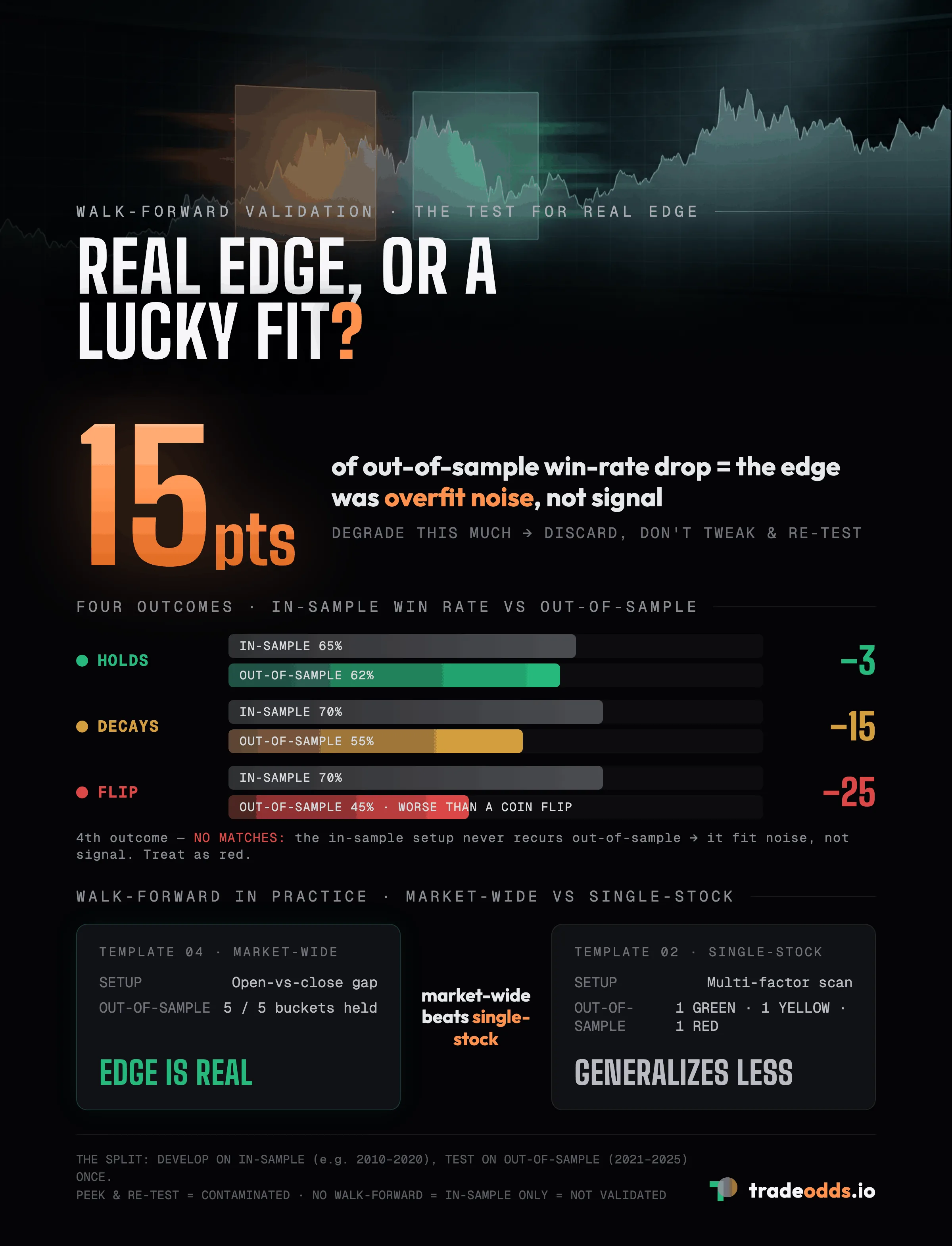
There are four common outcomes when you walk-forward validate:
-
Green — strategy holds. In-sample win rate ~65%, out-of-sample win rate ~62%. Mild degradation is normal; significant degradation is not. This is a strategy worth taking seriously.
-
Yellow — partial degradation. In-sample 70%, out-of-sample 55%. The strategy may have had real edge that decayed, or you may have moderately overfit. Worth investigating but not deploying as-is.
-
Red — flip. In-sample 70%, out-of-sample 45% (worse than random). The strategy was definitely overfit. Discard.
-
No matches. The conditions you fit on in-sample don’t occur in the out-of-sample window. This often means the in-sample setup was too specific — fitting noise rather than signal. Treat as red.
Walk-forward in TradeOdds
When TradeOdds publishes example backtest results (e.g. in product documentation or comparison content), the standard practice is to include walk-forward validation. A recent example using two templates from the internal validation suite (see /Context/walk-forward-validation-2026-05-08.md for the full report):
Template 04 — Open-vs-close gap by VIX move bucket. All 5 top in-sample buckets stayed CONSISTENT out-of-sample. The morning-entry edge is real.
Template 02 — NVDA multi-factor depth scan. Mixed: 1 GREEN, 1 YELLOW, 1 RED out-of-sample. Single-stock setups generalize less well than market-wide structural patterns.
Both results are useful to know. The first is something you can build on; the second is a warning to walk-forward-validate any single-stock setup you discover.
How to walk-forward in your own work
- Decide a fixed split before you start developing. “I’ll use 2010-2020 in-sample, 2021-today out-of-sample.”
- Do all development on the in-sample window only. All hypothesis generation, parameter tuning, model selection.
- When you’re done, run the final strategy against the out-of-sample window once.
- Accept the result. If it degrades 15+ percentage points, the strategy isn’t real. Don’t tweak and retest — you’ll re-contaminate.
- Optional: rolling walk-forward. Re-fit and re-test on multiple shifted windows for additional confidence.
Why this matters for live trading
You can do everything else right — clean data, correct forward-return alignment, proper commission modeling, realistic slippage — and still lose money in production because you overfit. Walk-forward is the single test that catches this.
It’s also what separates serious quants from amateurs. The amateur shows you a backtest with a 70% win rate. The serious quant shows you the in-sample and out-of-sample numbers, plus the year-by-year stability.
If a strategy’s published results don’t include walk-forward validation, treat them as in-sample only. Which means: not validated.
Related concepts
- Train / test / validation split. A three-way split common in ML. The validation set is the equivalent of out-of-sample, but used during model selection. The test set is the final-final verdict, used once.
- Cross-validation. Standard in ML — split data into k folds and rotate which fold is held out. Time-series data usually uses time-series cross-validation (don’t shuffle across time) instead of standard k-fold.
- Out-of-sample backtest. The same idea as walk-forward, but with a single fixed split rather than a rolling window.
Frequently asked questions
What is walk-forward validation in simple terms? Walk-forward validation splits your price history into an in-sample window you develop and tune the strategy on, and a separate out-of-sample window you test the finished strategy on once. If the edge holds up on data the model never saw, it’s more likely real. If performance collapses out-of-sample, you overfit.
What is the difference between in-sample and out-of-sample? In-sample is the period you use to build and tune the strategy. Out-of-sample is an untouched period you reserve to test the final version. You only look at out-of-sample once, after development is complete. Peek during development and re-tune, and it’s contaminated — effectively in-sample again.
How much out-of-sample degradation is too much? Mild decay is normal. As a rule of thumb, if the out-of-sample win rate drops about 15 percentage points or more from in-sample, treat the edge as overfit and discard it. A strategy that holds might go from 65% in-sample to 62% out-of-sample; a red flip goes from 70% to 45%, worse than a coin flip.
Why use walk-forward instead of a single train/test split? Market regimes change, so a single fixed split can pass or fail for reasons that have nothing to do with the strategy. Walk-forward re-fits and re-tests across multiple rolling windows, so a real edge has to hold across many different market conditions, not just one lucky period.
Does passing walk-forward validation guarantee future profits? No. Walk-forward lowers the odds of fooling yourself, but it can’t promise the future. Regimes can still shift in ways no past window contained. It’s the single best test for catching overfitting before you fund a strategy, not a guarantee that the edge will persist.
Disclaimer. TradeOdds provides historical analysis for informational purposes only. This is not investment advice. Past performance does not guarantee future results.
Try It Yourself
Run a free historical analysis on any stock, ETF, or crypto.
Start Free AnalysisNo account required. 10 free lifetime analyses.